
Glenville Sources for Previous Residents
Past residents leave different kinds of records at different times. Start with the current parcel to get its exact situs spelling, tax-map number, owner of record, mailing address, and any recent sale. Then move backward through deeds, maps, tax lists, directories, census material, and death-related sources. The exact beginning of the online county deed index was not located in official research, so older or difficult Glenville chains require a County Clerk visit or guidance. A street number alone is not enough when a record uses a farm, lot, subdivision, or metes-and-bounds description.
| Source | Years it covers | Where held | What it shows |
|---|---|---|---|
| County deed index | Online start not located; current SearchIQS route and older office route | Schenectady County Clerk and SearchIQS | Transfers, mortgages, liens, parties, and legal descriptions |
| Assessment and tax data | Current and historical RPS/tax-map data; earliest year not stated | Town and county-linked portals | Parcel, owner, assessment, exemptions, and sales/card fields |
| Glenville tax lists | 1821, 1822, and 1828 | Grems-Doolittle collection | Early taxpayer and property clues |
| County and town maps | 1850, 1856, and 1866 listed map years | Historical Society | Historic owners, roads, place names, and parcel context |
| Area directories and census | Directories from 1841–42; SCPL census microfilm 1790–1930 | SCPL and Digital History Archive | Household, occupation, residence, and local geography |
| House files, obituaries, wills | House forms from the 1970s/80s; wills 1809–1901; obituary runs vary | Historical Society, Surrogate, Digital History Archive | Structures, family ties, death endpoints, heirs, and executors |
For recent Glenville previous residents, start with the parcel record and deed chain. For nineteenth-century work, begin with a map, tax list, or directory entry and match it to a legal description. For household questions, the directory and census layer matters more than ownership alone. A permit can date a project or name an applicant, but no searchable Glenville permit index was located.
Start Glenville Previous Residents at the Parcel
The Town Assessor maintains physical inventory and ownership records, while Schenectady County processes deed transactions and sends updates for town data entry. BAS is the clearest public tax-bill route. Its search accepts Bill #, Tax Map #, Property Address, or Owner Name, one field at a time. For an address search, the portal instructs users to enter the number and street name without St, Rd, Ave, or Dr. Image Mate adds RPS data, tax maps, and photographic images, although its live search labels were not captured in the research review.
| Situs address | The physical parcel location in Glenville. Preserve its exact spelling for older searches. |
|---|---|
| Mailing address | The place where tax notices go. It can be different from the parcel and does not prove occupancy. |
| Tax-map number | The parcel identifier used to connect tax data, maps, and deed research. |
| Recent sale | A possible bridge to grantor, grantee, recording identifier, and deed date. |
| Assessment fields | Values, exemptions, and record-card details that should be confirmed with the custodian when material. |
Maps are useful for geography, not for proving a full household. The town-linked SIMS viewer, county mapping, and ArcGIS zoning viewer can show roads, parcel relationships, districts, Scotia, Alplaus, and surrounding context. For a current street-wide address trail rather than one backward address history, use the Glenville street address directory.
Note: A parcel’s mailing address is a correspondence field and may not identify the person living at the Glenville site.
Trace a Schenectady County Deed Chain
Recorded transfers are held by the Schenectady County Clerk and routed online through SearchIQS, which presents an account and subscription route. The public landing page did not expose a reliable live search form during research, so do not assume a particular field or image is available. The Clerk’s land-record page provides the portal route and a public-search quick-start guide. When the portal cannot complete the trail, ask the Clerk about older books, copies, and index access.
- Record the exact situs address, tax-map number, current owner, and recent sale from the parcel or tax record.
- Find the current owner’s purchase deed through the County Clerk route, keeping the instrument number or older book/page reference.
- Copy the legal description, document type, recording date, grantor, grantee, municipality, and image status when available.
- Search the prior seller as a grantee to locate that person’s acquisition, then compare the legal description rather than relying only on the street name.
- Repeat the process backward. If a party is an estate, add the Surrogate file; if it is an entity, add the Department of State history and filing address.
- Grantor
- The party transferring an interest in property in a recorded deed.
- Grantee
- The party receiving that interest. A former seller can become the grantee in an earlier purchase.
- Chain of title
- The linked sequence of recorded transfers for the same property, checked by legal description and parcel context.
- Legal description
- The deed’s formal description of land, often more durable than an old street address or postal label.
Glenville Previous Residents and Deed References
Glenville deed research crosses a recent identifier change. Image Mate states that documents recorded from December 10, 2024 use an instrument number instead of the older deed book and page reference. Record both formats when a chain reaches across the change. An older house-history instruction may direct a reader from Image Mate to a Liber and page, while a recent transfer needs the instrument number. This is a records-format change, not proof that a property changed hands on that date.
The County Clerk’s Transfer on Death Deed policy, effective July 19, 2024, is another special record type that can interrupt a simple sale-to-sale assumption. It covers deeds, revocations, and notices of fulfillment, and the county says such filings are indexed against the property. The clerk cannot provide legal advice. Read the document type and parties carefully before fitting it into a history of previous residents.
Note: Preserve the recording identifier and document type before drawing conclusions from a name that repeats in a parcel chain.
Glenville Previous Residents in Maps and Tax Lists
When a deed uses a vague description, historic maps and tax lists can rebuild the setting. Grems-Doolittle materials identify a 1850 town and county map with owners and features, a 1856 county ownership map, and an 1866 county atlas. Glenville tax-list copies survive for 1821, 1822, and 1828. They are early taxpayer and property clues, not household lists, but they can link a surname to a place before later parcel systems.
The same house-history guide points to the VB79 real-estate ledger from 1870–80 and Jonathan Pearson Street Books with deed, sketch, ownership, and street clues. Use a road, creek, mill, farm, or old path as a bridge when a current number does not appear. The Town Historian’s Percy Van Epps essays on place names, maps and deeds, mills, springs, Cayadutta, Maalwyck, Wolf Hollow, and old paths provide additional Glenville context.
Note: No official Glenville street-renumbering history was located, so do not assume a changed address reflects a documented renumbering.
Glenville Past Households in Directories and Census
Ownership is only one part of who lived here before. Schenectady-area city directories can place a household at a residence, identify an occupation, and link the name to a street listing. SCPL has Schenectady County census microfilm for 1790–1930, which can test the household layer against the directory record. The holdings, missing years, and entry-reading details belong in the Glenville city directory collections, while the work here is to arrange the dated records around one address.
The SCPL directory holdings identify the 1841–42 and 1857–58 volumes, the 1860 volume, the 1861–1968 run with gaps, later Colonie-Schenectady books, telephone books, and cross-reference material. Cross-reference directories offer an address-to-name route, but their annual continuity needs library confirmation.
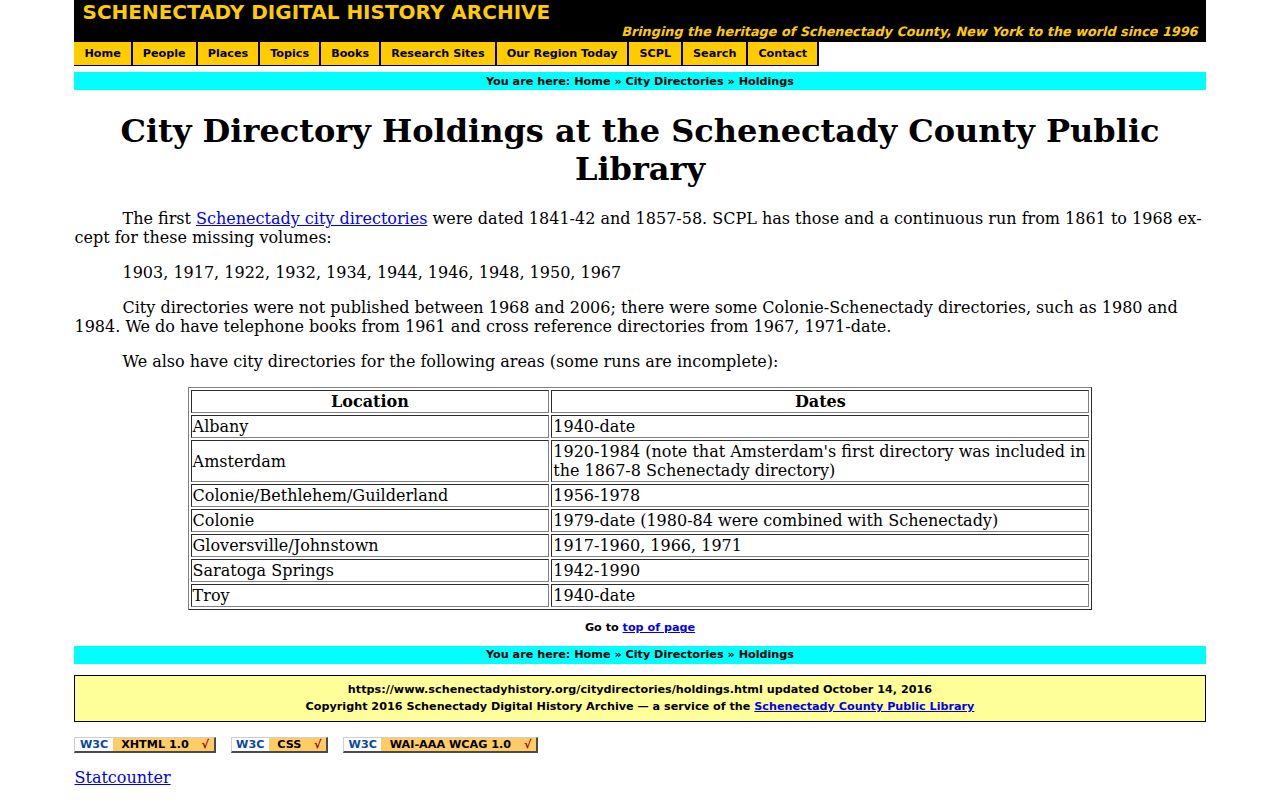
The holdings display makes the publication gaps visible. A name that vanishes can indicate a move, death, spelling change, a business-only listing, city-centered coverage, or a missing volume. It cannot, by itself, settle a Glenville household history.
- Match the parcel or legal description to the earliest reliable address wording.
- Find the closest directory year and copy the residence, occupation, and linked street information.
- Compare a prior and later directory, noting any gap between published years.
- Pair the closest census schedule with the address geography, household, age, birthplace, and occupation information.
- Use obituaries, probate, newspapers, and later maps to test the transition from one household to the next.
Glenville Previous Residents in House Files
The Grems-Doolittle Library collections are a practical fallback when a portal and deed index stop. Its house-history guide lists building and structure inventory forms from the 1970s and 1980s. The forms can include a name, address, present owner, original and current use, materials, structural system, condition, outbuildings, surroundings, features, significance, map, and photograph. Glenville is among the locations covered by the guide.
Appointments at Grems-Doolittle should be requested at least two business days ahead so material can be pulled. The collection also holds family histories, local genealogies, oral histories, diaries, newspapers, yearbooks, wills, naturalization records, maps, photographs, school records, church records, cemetery material, deeds, and personal papers. Staff and volunteer research help can point to the most useful file or catalog route.
Glenville Previous Residents at the Trail End
Obituaries and probate can explain what happened after a name leaves an address. The Schenectady Digital History Archive obituary index records surname, first name, a verified maiden name when available, newspaper code, date and page, death date when known, and notes. It is an index, not a certificate. County wills on microfilm cover 1809–1901, while the Surrogate’s Court route handles modern estate matters. An estate in a deed chain is a signal to check the probate trail for heirs, executors, and property context.
The Town Historian provides another local fallback, with obituaries back to 1812, town and school records, church records, directories, maps, abstracts of personal wills, census material, yearbooks, and military information. The office is especially helpful when a Glenville name is tied to a local feature, school, fire district, or family paper rather than a current street number.
Note: An obituary index points to a source and date; it does not replace the underlying obituary, certificate, or probate file.
Glenville Past Residents at Greens Corners
Greens Corners School Museum is a rare address-history lead. District #5 was established in 1815, a school deed dates to 1823, the brick building was built in 1825, and the school operated through 1946. Initials and names carved into the bricks include marks dating from 1866. For a family tied to that road landscape, the school can direct research toward yearbooks, obituaries, family files, school records, directories, and the Historian’s collection.
Its history should not be used as a roster of past residents. Instead, pair a school clue with a dated map, deed, tax list, or directory. Glenville’s town, village, postal, fire-district, and historic-place labels can all appear in the same address trail.
Limits on Glenville Previous Residents Records
Public documents are role-based. They may name an owner, a deed party, a taxpayer, an applicant, a person in a historic directory, or an estate participant. They do not create a complete record of every former occupant. A mailing address is not a residence finding, and an adjacent parcel is not a household roster. DMV data, private utility accounts, sealed records, protected voter addresses, and unlisted contact details are not ordinary public research channels.
Use records lawfully. Glenville house and family research is appropriate for history, genealogy, estate questions, and personal curiosity. Do not use public records to harass, threaten, track, or contact a living person without a legitimate purpose; New York’s stalking law addresses repeated conduct that causes reasonable fear or harm.
The County Clerk’s free Record Alert program offers a separate safety tool for documents recorded under up to three names per email address or phone number. It is a monitoring alert, not a title guarantee. Confirm a notice with the County Clerk rather than a return address in an unexpected letter.