
Glenville City Directory Collections and Access
Glenville research relies heavily on Schenectady-area volumes. The Schenectady County Public Library holds most Schenectady directories, older copies for nearby places, and related area material. That regional scope matters. A family connected with Glenville can be indexed under Schenectady, Scotia, Alplaus, or another locality label. The holdings begin with 1841–42 and 1857–58, then include 1860 and a long run from 1861 through 1968. These city directory collections are strongest when the searcher records the locality printed in the volume instead of assuming a modern town label.
| Collection | Years | Where held | Access |
|---|---|---|---|
| Schenectady city directories | 1841–42; 1857–58; 1860; 1861–1968 with gaps | SCPL and Digital History Archive | Physical holdings and digitized material |
| Colonie-Schenectady directories | 1980 and 1984 | SCPL | Library collection |
| Telephone books | From 1961 | SCPL | Confirm the exact run with the library |
| Cross-reference directories | 1967; 1971 to present | SCPL | Address-to-name route; verify annual continuity |
The library names missing volumes for 1903, 1917, 1922, 1932, 1934, 1944, 1946, 1948, 1950, and 1967. No printed directories were published from 1968 through 2006. A missing entry in one of those years is not proof that a Glenville household was absent. It may reflect a publication gap, city-centered coverage, a spelling variant, or a business-only listing. The directory holdings page is the right place to check the available run before planning a year-by-year search.
Glenville City Directory Roots in 1841
The earliest digitized area volume is the 1841–42 Schenectady Directory and City Register. It identifies heads of families, firms, and people conducting business, then divides material into names, streets, business categories, clergy, Union College faculty, public officials, and advertisements. J. & W. H. Riggs printed the book at 23 Union-Street. The compiler called it a first attempt and warned that errors and omissions could remain. That warning is useful evidence, not a reason to dismiss the volume.
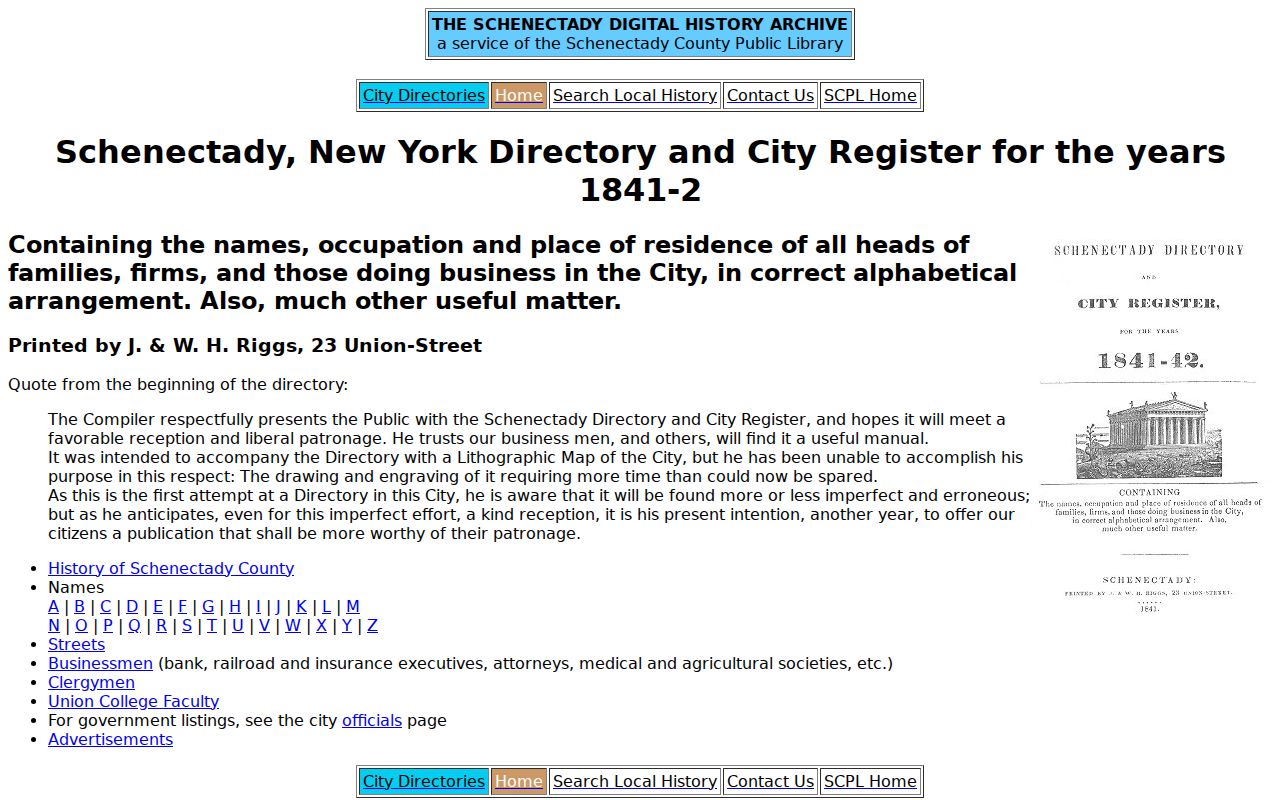
The title and section layout show why the volume supports more than a single-name search. A reader can move from an alphabetical entry to a street, business, or public-office reference. Since the book is principally a Schenectady directory, treat any Glenville connection as regional evidence that needs a second record.
For early Glenville work, county formation and town history matter. Schenectady County began in 1809, while the Town of Glenville was created in 1820 and organized in 1821. Earlier families can appear in Albany County records, church registers, tax lists, wills, maps, and newspapers before a modern municipal trail exists.
Glenville City Directory Research at SCPL
The SCPL local-history guide places directories beside Schenectady County census microfilm for 1790–1930, yearbooks, government records, local newspapers back to 1822, atlases, DAR rolls, and newsletters. That mix lets a reader test a directory address against a census household, school reference, obituary, or map. The Glenville Branch is at 20 Glenridge Road and can be reached at 518-386-2243. Some databases have library-access conditions rather than unrestricted online access.
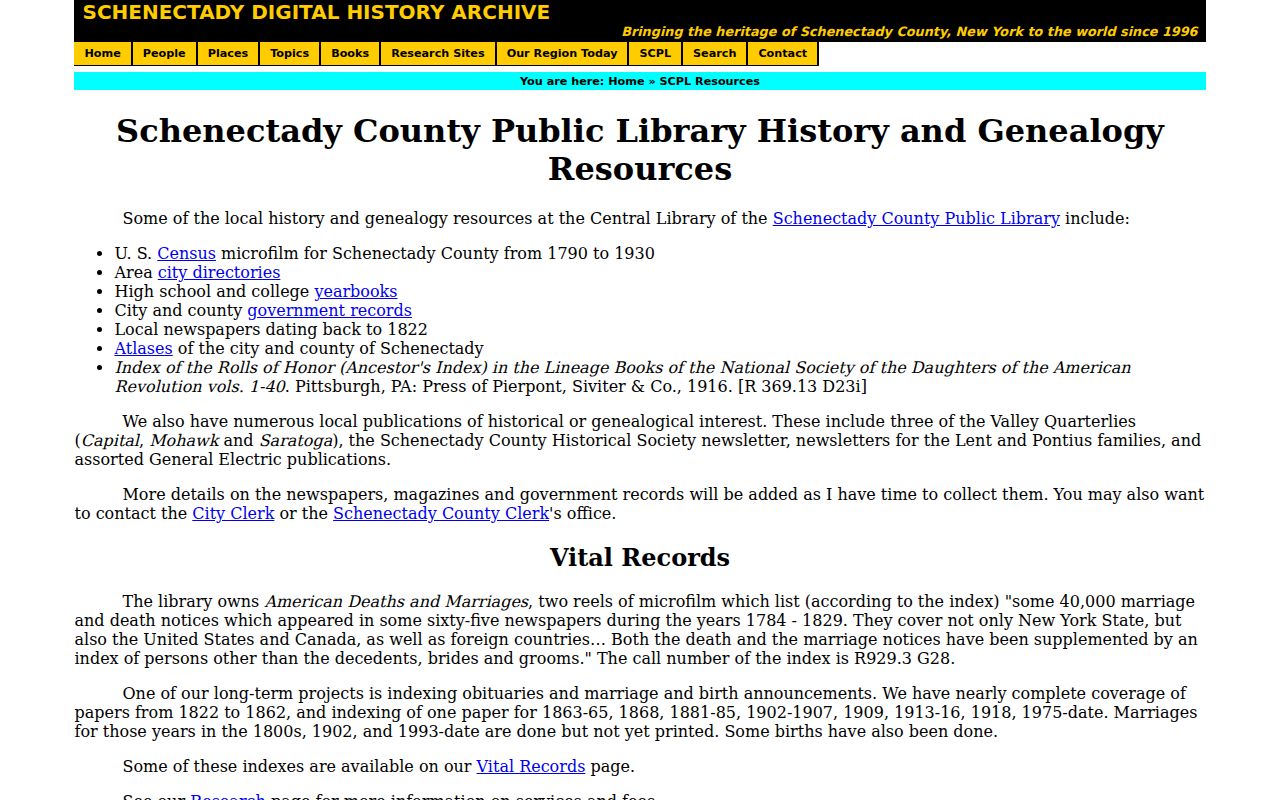
SCPL also identifies America’s News coverage for the Daily Gazette from August 15, 1997 to the present and the Times Union from March 1986 to the present. Ancestry Library Edition is available on Main Library computers or its free wireless. These resources can help distinguish people with the same name, but a newspaper or database hit still needs its date and source recorded.
How a Glenville City Directory Entry Reads
A city directory entry is compact, so copy it exactly before drawing a conclusion. The digitized 1841 name page can show a surname and given name, relationship or status wording, occupation or business, a work address, a residence address, and a link to the street listing. A person’s shop, yard, or office can be on a different street from the home. The entry should therefore be read as a dated record of the role printed, not as a complete household roster.
The digitized name-entry page demonstrates the linked format, including occupations and street references.
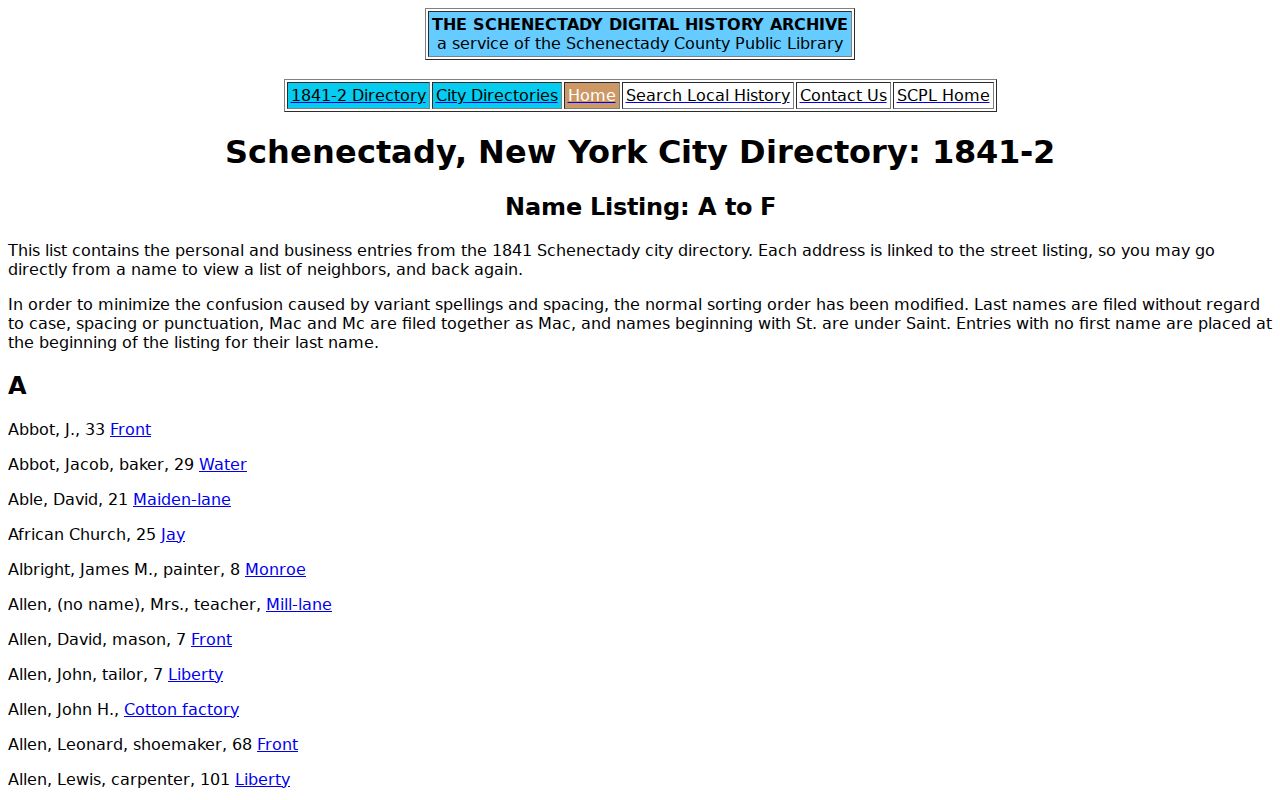
The street link permits a return trip from a name to nearby entries, while the name page can bring the reader back to an alphabetic listing. Preserve both business and residence locations when they differ. This helps avoid attaching a trade address to the wrong household.
| Name and status | Alphabetical surname and given name, sometimes with Mrs., widow, or other relationship wording. |
|---|---|
| Occupation or business | A trade, service, shop, yard, office, or other work description. |
| Work location | A business street or number that may differ from the residence. |
| Residence line | The printed home street or number when the entry supplies one. |
| Street connection | A linked street sequence that can identify adjacent listed names. |
- Criss-cross directory
- A later directory arranged by address or street, used to approach a listing from the property side rather than the surname side.
- Householder index
- An index organized around the named household contact, which may not identify every person at the address.
- Abbreviation key
- The volume’s explanation of its shortened labels. Check it before expanding a mark in notes or a family tree.
Note: A business address and a residence address may name the same person but describe separate places in the 1841 volume.
Glenville City Directory Gaps and Changes
The local directory timeline has real breaks. Treat those breaks as part of the evidence. The first listed volumes are 1841–42 and 1857–58. A later series reaches 1968 but omits named years, and printed publication then pauses through 2006. Cross-reference directories provide an address route for 1967 and 1971 to the present, while telephone books begin in 1961. Colonie-Schenectady volumes for 1980 and 1984 offer later suburban context.
- 1841–42: first digitized Schenectady directory and register.
- 1857–58 and 1860: later early holdings listed by SCPL.
- 1861–1968: long Schenectady run, with identified missing years.
- 1968–2006: no printed directories published.
- 1967 and 1971 onward: cross-reference material listed by SCPL, with continuity to confirm.
Note: A missing volume or regional title can hide a family without showing that it left Glenville.
Trace Glenville Families in City Directories
Use a set of city directories as a time series, not a one-time name check. Begin with a known spelling and an approximate date. Capture the address, occupation, relationship wording, and street link. Search a prior and later volume, then compare the changes with census schedules. SCPL holds Schenectady County census microfilm through 1930, which is especially useful for testing whether a directory entry describes the same household across a decade.
- Find the earliest likely name entry and copy its spelling, work description, residence, and any status wording.
- Open the street link and record adjacent entries without assuming that every listed neighbor was related.
- Check an earlier and a later directory, allowing for the named gaps and variations in locality labels.
- Pair the closest directory years with the relevant census schedule, then compare age, household, occupation, and address geography.
- Use an obituary, cemetery record, probate file, or newspaper notice to test whether a disappearance reflects death, a move, or an unlisted year.
A person who disappears may have moved, died, changed spelling, appeared only as a business contact, or fallen in a publication gap. The Glenville resident search is the better next step when a historical identity needs a current official-record check.
Glenville Directory Evidence at Grems-Doolittle
The Grems-Doolittle Library adds the material that a directory cannot supply alone: local histories, family papers, newspapers, yearbooks, wills, naturalization records, maps, photographs, school and church records, cemetery material, deeds, and personal papers. It is at 32 Washington Avenue in the Stockade. Appointments must be requested at least two business days ahead so staff can pull materials, and staff or volunteer research help is available.
Its house-history guide points to historic maps, tax lists, city directory years, wills, building inventories, and the History Forge mapping layer. That makes it a strong route when a directory gives only a street or an occupation. For a modern parcel-to-owner sequence, use the Glenville street address directory rather than treating a historic listing as current evidence.
Glenville City Directory Locality Clues
Glenville research needs flexible place names. Scotia is a village within the Town of Glenville, while Alplaus is a separate named community with a distinct postal identity. East Glenville, West Glenville, Thomas Corners, Beukendaal, Glenville Hills, Hoffman’s, Rectors, and Scotia also appear as local geography. A directory may favor Schenectady, a postal city, a village, a road, or a historic feature instead of the present town wording.
The Town Historian’s Percy Van Epps essays on place names, maps and deeds, mills, springs, Cayadutta, Maalwyck, Wolf Hollow, and old paths can bridge an old description to a current area. A directory result should retain the original wording first, then be compared with a county map, deed description, or historian collection.
Note: Keep Scotia, Alplaus, and postal labels exactly as printed because directory and town terminology does not always match.
Glenville City Directory Clues at Greens Corners
Greens Corners School Museum offers a focused family-history lead. District #5 was established in 1815, its deed dates to 1823, the brick school was built in 1825, and it remained active through 1946. The building preserves initials and names carved into bricks, including marks dating from 1866. Those details can lead to school records, yearbooks, obituaries, family files, and city directories.
The museum is a person-to-place clue, not a complete former-pupil roster. Pair a school lead with the Town Historian’s school records and the Historical Society’s education collections. This preserves the date and setting of a name before it is connected to a wider Glenville family trail.